Last verified: September 2026
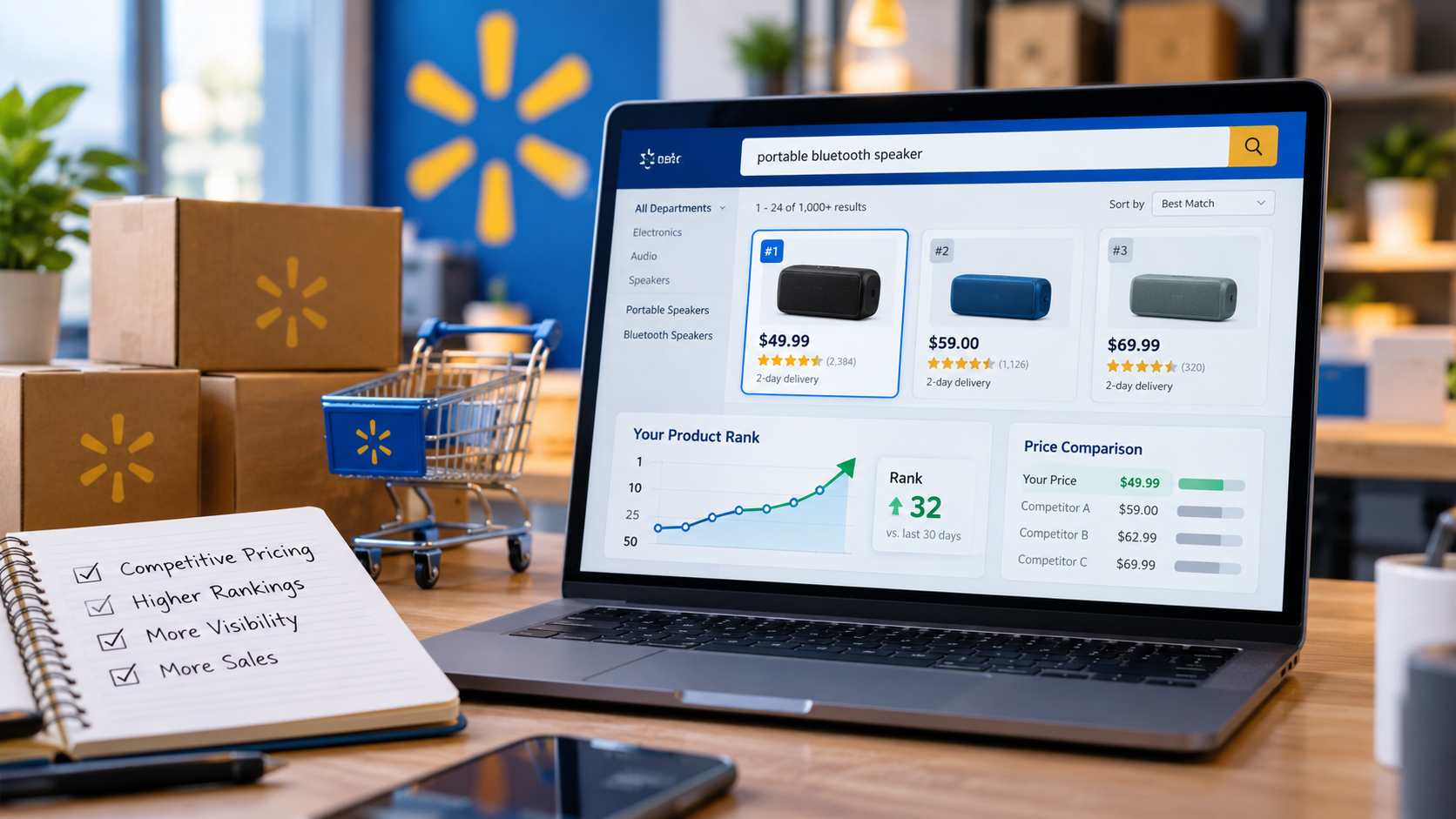
Most Walmart sellers treat search ranking and pricing as two separate problems: one for their content team, one for their operations team. Walmart’s Polaris algorithm does not make that distinction. Price competitiveness is a direct input into Walmart’s search ranking evaluation, which means a repricer is not just a Buy Box tool: it is a Walmart search visibility tool. This article explains how Walmart’s search algorithm evaluates offers, why pricing sits inside the ranking calculation rather than alongside it, and the practical steps for improving Walmart search rank through competitive pricing.
TL;DR: Walmart’s Polaris algorithm evaluates offer quality, including price competitiveness, as a search ranking signal alongside content relevance, seller performance, fulfillment method, and reviews. A listing priced outside Walmart’s competitive window loses search placement at the same time it loses Buy Box eligibility. Automated repricing keeps offers within the competitive range continuously, which supports both Buy Box rotation and search visibility. Weak on pricing, and the other four ranking factors cannot compensate.
How Walmart Marketplace search ranking works
Walmart’s Polaris algorithm evaluates offers on a unified set of factors including relevance, offer quality, seller performance, and fulfillment, and produces a single ranked result for each search query. Price sits inside the offer quality evaluation, not outside it.
When a buyer searches on Walmart.com, Polaris determines which products appear and in what order. The ranking is not a pure relevance match the way early search engines worked. Polaris evaluates the full offer: whether the item is well described, competitively priced, likely to ship on time, and backed by a seller with a strong performance record. All five factors contribute to position simultaneously.
The five main factors Polaris evaluates:
- Relevance: how closely the product title, attributes, and description match the search query. This is the content side of Walmart SEO: keyword placement in the first 50 characters of the title, attribute completeness, and description quality all feed into this score. Unlike Amazon, Walmart has no backend keyword field, so all keyword content must appear in visible listing copy.
- Offer quality: the competitiveness of the price relative to other offers on Walmart.com. Walmart’s brand is built on everyday low prices; the algorithm reflects that positioning by favoring offers that represent clear value to the buyer. An offer priced above the market median for a product ranks below one priced competitively, even if the overpriced listing has stronger content.
- Seller performance: order defect rate, cancellation rate, late shipment rate, and overall seller health score in Seller Center. Sellers with poor performance records are demoted in search results even when their listings and prices are competitive. Performance thresholds are published in Seller Center; falling below them applies a ranking penalty that persists until performance recovers.
- Fulfillment method and speed: listings enrolled in WFS or Walmart’s TwoDay or ThreeDay Delivery program receive a ranking boost because Walmart can guarantee the delivery promise to the buyer. Standard seller-fulfilled listings without a speed badge rank lower, all else equal.
- Review profile: review count and average star rating. Listings with no reviews or a low average rating rank below comparable listings with stronger review profiles, because the algorithm treats reviews as a proxy for buyer confidence in the product and the seller.
The key difference from Amazon: Amazon’s A9 algorithm is primarily relevance-driven with conversion signals layered on top. Walmart’s Polaris algorithm weights offer quality, including price, more explicitly as a search ranking factor. This is consistent with Walmart’s corporate positioning as a price-leadership retailer. A relevance-matched but overpriced listing ranks lower on Walmart than it would on Amazon.
Why price competitiveness is a Walmart search ranking signal
Walmart’s algorithm treats a competitively priced offer as a higher-quality offer, not just for the Buy Box, but for search rank. An offer priced outside the competitive window is scored as lower quality in Polaris, which suppresses both Buy Box eligibility and organic search position simultaneously.
The mechanism works through two connected layers.
Layer 1: Direct offer quality scoring
When Polaris evaluates an offer for search ranking, it assesses whether the price is competitive relative to other offers on the same listing and within the broader category. Walmart does not publish the exact formula, but the observable outcome is consistent: offers priced above the market median for a product rank lower in search results, even when their listing content is strong.
Walmart’s price-leadership mission explains why. Walmart.com surfaces products it can credibly present as value to buyers. An overpriced offer contradicts that mission, so Polaris scores it lower in the offer quality evaluation and ranks it accordingly.
Layer 2: Buy Box and search placement are linked
The Buy Box winner on a Walmart shared listing receives the primary placement in search results for that product. A seller who wins the Buy Box appears at the top of the search result; a seller who loses the Buy Box receives a secondary placement or no direct search presence on that listing.
Winning the Buy Box requires a price within approximately 3% of the lowest offer on the listing (Maxmerce, December 2025). A seller priced outside that window loses Buy Box eligibility, and with it, the primary search placement that Buy Box winners receive. Losing the Buy Box on pricing grounds means losing search visibility for that listing, not just Buy Box share.
The two layers compound: an overpriced offer receives a lower direct offer quality score AND loses the primary search placement that comes with the Buy Box. Both penalties apply at the same time, and both are resolved by the same action: pricing competitively.
The seller blind spot: Most Walmart sellers who invest in listing optimization but neglect competitive pricing assume their content work will lift their search rank. It will, to a point. The relevance layer rewards strong content. But strong content in a listing priced above the competitive window is scored against a lower offer quality rating simultaneously. The content gain and the pricing penalty operate in parallel; fixing only one resolves only part of the ranking suppression.
The connection between repricing and Walmart search visibility
Manual price management cannot maintain the competitive window continuously at catalog scale. When price drifts outside Walmart’s Buy Box threshold, search visibility and Buy Box share drop together. Automated repricing is what keeps both metrics stable.
Walmart’s competitive pricing environment is not static. Competitor prices change, sometimes multiple times per day, as sellers adjust to promotions, new inventory, and competitive pressure. The floor of the 3% Buy Box window moves with those changes. A price that was competitive yesterday may sit outside the window today if a competitor ran a promotion, received new stock, or adjusted their minimum.
Manual price reviews, even daily ones, create gaps: periods during which your price sits above the competitive threshold and your search placement drops. At catalog scale (50 or more listings), those gaps are continuous rather than occasional, because a daily review cannot address all listings simultaneously and some will have drifted between checks.
Automated repricing solves this by monitoring competitor prices and adjusting your price to stay within the eligibility window. The result is continuous competitive positioning rather than periodic corrections. Both Buy Box eligibility and the search placement that comes with it are maintained across the catalog, not only on the listings that happened to be reviewed most recently.
What this means for your Walmart SEO investment:
Search ranking on Walmart is partly controlled through content work and partly dependent on continuous pricing maintenance. Content work has a lasting effect: a well-structured title and complete attribute set do not need to be refreshed daily. Pricing does require continuous attention because the competitive window moves with the market. A repricer is the only way to maintain that at catalog scale without a team of people monitoring prices manually.
RepricerExpress Walmart repricing monitors competitor prices and applies your competitive rules automatically, across your full Walmart catalog, without manual intervention. The effect on search visibility is indirect but consistent: competitive pricing keeps Buy Box eligibility in place, and Buy Box eligibility keeps the primary search placement in your hands rather than rotating to a competitor.
Other ranking factors: content quality, fulfillment speed, seller performance
Competitive pricing is the factor most sellers underinvest in relative to its search ranking impact, but it does not operate alone. Listing quality, fulfillment method, seller performance, and review profile each contribute to where your product appears in Walmart search results. Optimize all five; do not treat them as alternatives.
Listing quality (content relevance)
The relevance layer of Polaris evaluates your product title, attribute completeness, and description against the search query. Walmart’s Polaris algorithm weights item completeness at approximately 40% of its Buy Box scoring (Maxmerce, 2026), which reflects the same signal: a listing with poor content quality is scored lower across the algorithm’s evaluations, not just in the search relevance layer.
For search ranking, the highest-impact content elements are title structure (primary keyword in the first 50 characters, Brand + Model + Key Feature + Size format, 50-75 characters total), attribute completeness for your category, and description length and keyword coverage. The Walmart product listing optimization guide covers the full checklist including image requirements and the Item Quality dashboard.
Fulfillment method and speed
WFS-enrolled listings receive a ranking boost because Walmart can guarantee the delivery promise. WFS listings win the Buy Box 68% more often than equivalent seller-fulfilled listings at comparable prices (Maxmerce, 2026). That Buy Box advantage translates directly to higher primary search placement for those listings. Sellers using Walmart’s TwoDay or ThreeDay Delivery program without WFS receive a partial boost; standard seller-fulfilled listings without a speed badge rank lowest on the fulfillment factor.
Seller performance
Walmart’s algorithm applies a ranking penalty to sellers with elevated order defect rates, cancellation rates, or late shipment rates. A competitive price on a poor-performing seller account ranks below a slightly higher price from a seller with clean performance metrics. Performance thresholds are published in Seller Center; sellers falling below them should treat performance recovery as a prerequisite for any other ranking improvement, because the penalty overrides the other factors until it is resolved.
Review profile
Review count and average rating feed into Polaris as social proof signals. Listings with a strong review profile rank higher than comparable listings with few or no reviews. Walmart’s review accelerator program is the primary tool for building review velocity on new or recently launched listings. A low average rating pulls rank down regardless of price and content quality, so maintaining a positive rating profile is part of ongoing Walmart search optimization, not a one-time setup task.
A practical approach to improving Walmart search rank through repricing
The highest-return sequence for improving Walmart search rank is: fix listing quality first, then competitive pricing, then fulfillment upgrade if the economics support it. Pricing is the only factor that requires continuous maintenance; the others, once corrected, hold their position without daily attention.
Step 1: Audit your current search positions and Buy Box win rates
In Walmart Seller Center’s Analytics and Reporting section, identify which listings are underperforming. Compare search visibility against Buy Box win rates per listing:
- Low Buy Box win rate + low search visibility: pricing is the primary suppressor
- Acceptable Buy Box win rate + low search visibility: content quality or seller performance is likely the issue
- High Buy Box win rate + low search visibility: seller performance penalty may be active despite competitive pricing
Step 2: Fix listing quality for flagged items
Before adjusting pricing rules, confirm each listing’s Item Quality dashboard status is passing. A listing suppressed for quality issues has a content ceiling that competitive pricing cannot lift it above. Resolve quality flags first, wait 24-48 hours for Walmart to re-index, then move to pricing.
Step 3: Configure competitive repricing rules in RepricerExpress
Calculate your Walmart minimum price per listing using the formula: (COGS + fulfillment cost) divided by (1 minus referral fee percentage minus target margin percentage). The full calculation with a worked example is in the Walmart Buy Box repricing guide.
Set your competitive range:
- Seller-fulfilled listings: 1-2% of the lowest offer
- WFS listings: 2-3% of the lowest offer (the WFS fulfillment premium provides tolerance for a slightly higher price while maintaining Buy Box eligibility)
Ensure your Walmart maximum price does not exceed your Amazon price for the same SKU: Walmart’s Price Parity Rule suppresses Buy Box eligibility if your Walmart price is higher.
Step 4: Allow 72-96 hours and monitor both metrics together
Activate rules and allow 72-96 hours before evaluating performance. Walmart’s search position data updates with a lag; a shorter window does not give reliable results. Monitor Buy Box win rate and search position together in Seller Center. A Buy Box win rate improvement should correlate with a search position improvement for the same listing within a few days.
Step 5: Review fulfillment for top-volume listings
If Buy Box win rate and search position remain below target after step 3, review WFS eligibility for your top-volume listings. The 68% Buy Box advantage for WFS-enrolled listings (Maxmerce, 2026) produces a search placement advantage that competitive pricing alone cannot replicate for a seller-fulfilled listing competing directly against a WFS offer at a similar price.
Key Takeaways
- Walmart’s Polaris algorithm evaluates price competitiveness as a search ranking signal within the offer quality factor, not only as a Buy Box input; an overpriced listing loses search placement and Buy Box share at the same time
- Buy Box winners receive the primary search result placement for a shared listing; Buy Box eligibility requires a price within approximately 3% of the lowest offer (Maxmerce, December 2025), connecting competitive pricing directly to search visibility
- Manual price management creates drift windows during which price falls outside the competitive threshold and search placement drops; automated repricing maintains continuous positioning across the full catalog
- The five Walmart ranking factors are: relevance, offer quality (including price), seller performance, fulfillment method and speed, and review profile; competitive pricing is the only one that requires continuous maintenance
- The correct optimization sequence: fix listing quality, then set competitive repricing rules, then consider fulfillment upgrade
- Treating Walmart SEO and repricing as separate activities leaves the offer quality ranking factor unmanaged and limits the return on listing quality investment
Action Plan
- Pull Buy Box win rate by listing from Walmart Seller Center’s Analytics and Reporting section and identify listings with win rates below target
- Check each underperforming listing’s Item Quality dashboard status in Seller Center and resolve any quality flags before adjusting pricing
- Calculate your minimum price per listing using the formula in the Walmart Buy Box repricing guide, then configure competitive rules in RepricerExpress (1-2% range for seller-fulfilled, 2-3% for WFS)
- Confirm your Walmart maximum price does not exceed your Amazon minimum for the same SKU before activating any rules
- Allow 72-96 hours after activation and monitor Buy Box win rate and search position together in Seller Center
- For any listing where Buy Box win rate improves but search position does not, check your seller performance metrics for an active penalty in Seller Center
- For top-volume listings competing against WFS sellers, evaluate WFS enrollment to access the fulfillment-driven ranking and Buy Box advantage
Frequently Asked Questions
1. How does Walmart Marketplace search ranking work?
Walmart’s Polaris algorithm ranks listings based on five factors: relevance (how well your title, attributes, and description match the search query), offer quality (including price competitiveness), seller performance (order defect rate, cancellation rate, late shipments), fulfillment method and speed (WFS and TwoDay listings rank higher), and review profile (count and average rating). The algorithm reflects Walmart’s everyday low price positioning: offers that represent good value to buyers rank above equivalent offers priced above the market median. Unlike Amazon’s algorithm, which is primarily relevance-driven, Polaris weights price competitiveness more explicitly as a quality signal within the ranking formula.
2. Does pricing affect my Walmart search rank?
Yes. Price competitiveness is an input into the offer quality factor, which is one of the five Polaris ranking criteria. An offer priced above the competitive window for its listing is scored as lower quality, which suppresses its search position. The effect is compounded by the Buy Box connection: the Buy Box winner on a shared listing receives the primary search result placement, and Buy Box eligibility requires a price within approximately 3% of the lowest offer (Maxmerce, December 2025). An overpriced listing loses both its direct offer quality score and its Buy Box-linked search placement simultaneously.
3. How do I rank higher on Walmart Marketplace?
The highest-return sequence: fix listing quality first (title structure, attribute completeness, image count), then set competitive repricing rules to maintain a price within 1-3% of the lowest offer, then review your seller performance metrics for any active penalties. WFS enrollment adds a ranking boost on top of these factors, but the baseline (listing quality, competitive pricing, and clean performance) must be in order first. Treating Walmart SEO and repricing as separate activities leaves the offer quality ranking factor unmanaged and limits the return on content investment.
4. Is Walmart SEO different from Amazon SEO?
Yes, in two important ways. First, price competitiveness is a more explicit ranking signal on Walmart than on Amazon. Walmart’s algorithm treats a competitively priced offer as a higher-quality offer within the search ranking calculation. Amazon’s A9/A10 algorithm weights relevance and conversion signals more heavily and is less explicitly price-driven in its ranking logic. Second, Walmart has no backend keyword fields: all keyword content must appear in visible listing copy, making the product title the primary keyword vehicle rather than a combination of title and backend search terms. Walmart SEO therefore requires both listing content work and continuous competitive pricing maintenance; the two address different layers of the same algorithm.
5. How do I improve my Walmart search ranking quickly?
The fastest gains come from correcting listing quality issues (which removes content-layer suppression) and restoring price competitiveness (which removes offer quality suppression). Both are independent suppressors and both can be corrected quickly. Fix Item Quality dashboard flags and activate a competitive repricing rule in RepricerExpress. Expect Buy Box win rate to respond within 24-72 hours of the pricing rule going live, and a corresponding improvement in search position within a few days as Walmart’s index reflects the updated offer quality score.
Ready to stop managing prices manually? Start a free 14-day trial at repricerexpress.com/book-demo-2/.