Last verified: September 2026
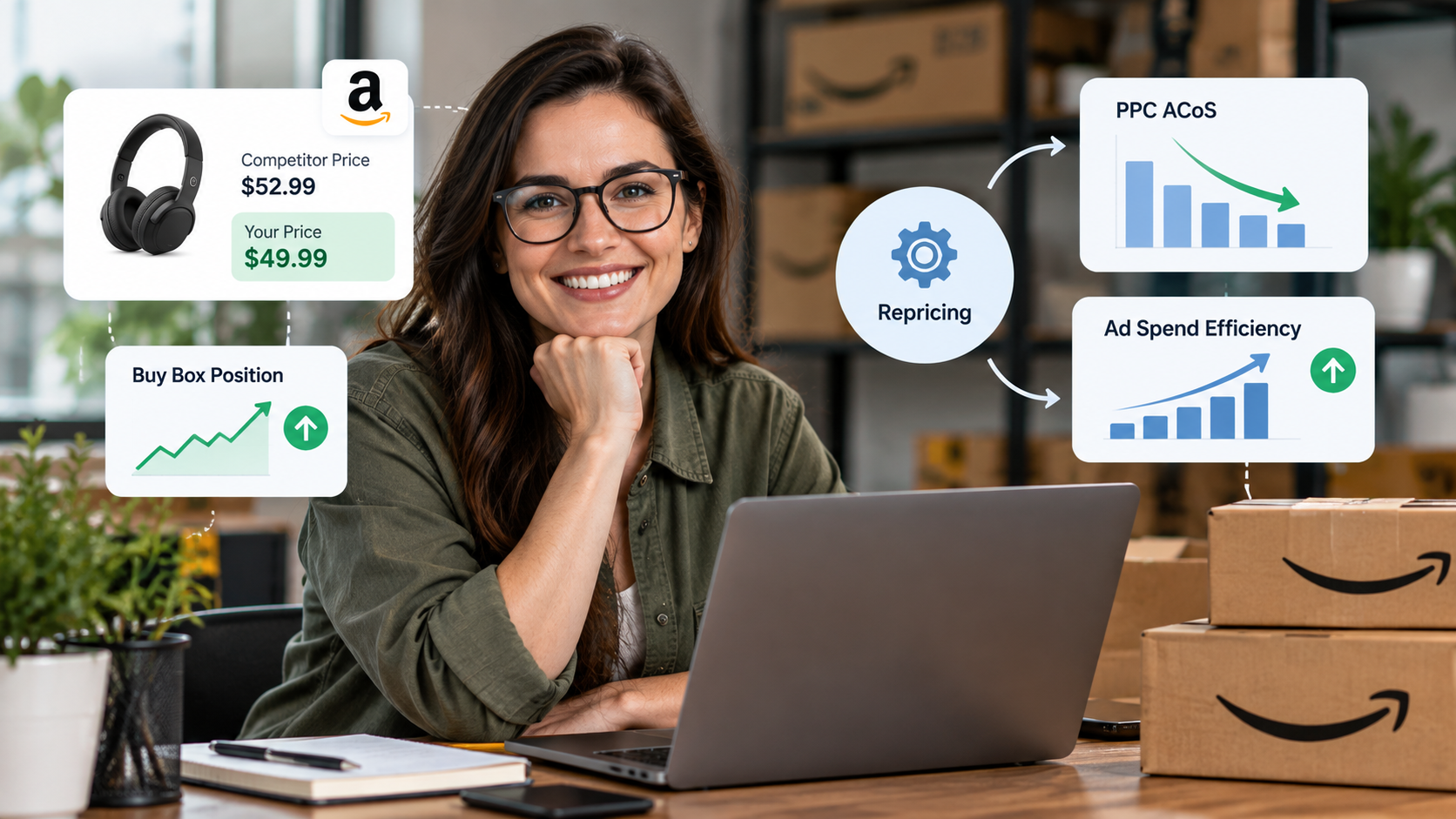
Most sellers treat their repricer and their ad campaigns as separate tools. They are not. Every price change your repricer executes feeds directly into your ACoS: through conversion rate, through revenue per unit, and through Buy Box eligibility. Sellers who manage the two without understanding that connection end up optimizing one at the cost of the other. This article explains the mechanism and gives you the rule configuration to protect both.
TL;DR: ACoS = Ad Spend divided by Ad Revenue. Ad Revenue = Price multiplied by Units Sold. Every time your repricer lowers your price to win the Buy Box, revenue per unit falls, and ACoS rises unless conversion improves by more than the price dropped. Losing the Buy Box is worse: your ads stop running entirely. The minimum price floor is what prevents your repricing rules from damaging your advertising efficiency. Set it before you run either tool.
The link between Amazon pricing and advertising cost of sale
ACoS is a ratio: ad spend divided by the revenue those ads generated. Your price sits inside that ratio, and every price change your repricer makes moves it.
Amazon defines ACoS as:
ACoS = Total Ad Spend ÷ Total Sales (attributed to ads)
Total sales equals units sold times price. Which means:
ACoS = Ad Spend ÷ (Units Sold × Price)
When price goes down, the denominator shrinks unless units sold increases enough to compensate. When price goes up, the denominator grows and ACoS falls, provided you hold the Buy Box and conversion does not drop significantly.
Most sellers think of repricing as a Buy Box tool and think of PPC as a traffic tool. They are working on the same number from opposite sides. Your repricer determines price, and price determines the revenue side of your ACoS formula. Your ad campaigns determine spend, and spend determines the cost side. Neither tool operates independently.
The direction of the relationship is consistent: a price increase that holds the Buy Box will improve ACoS. A price cut that wins the Buy Box will worsen ACoS unless conversion improves proportionally. And losing the Buy Box collapses the situation in a different way: ad spend continues while attributed sales stop. For more on Buy Box mechanics, see our guide to winning the Amazon Buy Box.
Why winning the Buy Box through price cuts can inflate your ACoS
Lowering your price to win the Buy Box increases conversion rate. But conversion rate improvement rarely offsets the revenue-per-unit reduction, which means ACoS rises even as you sell more units.
Here is the math made visible. Assume a product at $20.00, with 100 units sold through ads on $100 of ad spend:
ACoS = 100÷(20 × 100) = $100 ÷ $2,000 = 5.0%
Your repricer drops the price to $18.00 to win the Buy Box. Conversion improves 8%, a meaningful increase.
ACoS = 100÷(18 × 108) = $100 ÷ $1,944 = 5.1%
ACoS worsened even though you sold more units and won more Buy Box share. For ACoS to hold flat at 5.0% after a 10% price cut, units sold would need to rise by approximately 11%. For ACoS to improve, units would need to increase by more than 11%. Whether that happens depends on the price sensitivity of the specific ASIN and category. In many categories, a 10% price cut does not move unit volume by 10% or more.
The practical implication: running an aggressive repricing rule while running PPC without a minimum price floor can produce a situation where your ads are technically performing better (more clicks, more conversions) while your ACoS climbs steadily because each sale generates less revenue. The two metrics move in opposite directions and both appear to be working until you look at the interaction.
The situation where this matters most is during active PPC campaigns. When you increase ad spend, you are paying more to drive traffic to a listing whose price your repricer may be moving downward at the same time. Ad spend rises; revenue per unit falls; ACoS deteriorates from both directions simultaneously. The repricing rule and the PPC campaign need to be configured as a system, not as independent tools.
The Buy Box as a prerequisite for PPC performance: what happens when you lose it
Sponsored Product ads on Amazon only display when the seller holds the Buy Box. No Buy Box, no ad impressions. Ad spend stops working, not because the campaign is wrong, but because the listing is ineligible.
Amazon’s Sponsored Products documentation confirms that your ad only serves when you have the featured offer on the ASIN. This is a hard eligibility check, not a preference. When a competitor undercuts your price and wins the Buy Box, your ad stops appearing in search results and product pages. The campaign continues, but impressions drop to zero.
The result on your ACoS report looks like a sudden improvement: no impressions means no spend, and no attributed sales appear in the ad column. That can mask what has happened: you have lost traffic to the listing entirely.
For sellers running PPC, this means the Buy Box and ACoS are connected in a second way. Losing the Buy Box does not inflate ACoS. It shuts down the ad entirely. Which is why sellers focused on ACoS efficiency, even those willing to raise prices to improve it, still need to monitor their Buy Box win rate at the same time. A price strategy that improves ACoS by reducing the number of days you hold the Buy Box is not a successful strategy.
The two failure modes are:
- Repricing too aggressively: price falls, revenue per unit falls, ACoS climbs despite higher conversion.
- Not repricing aggressively enough: price holds too high, Buy Box is lost, ads stop running entirely.
The minimum price floor is what separates these two failure modes. At the right minimum, your repricing rule finds the lowest price that holds the Buy Box, and your ads run at the best price your margin will support.
How to set a minimum price that protects both margin and ACoS
The minimum price has to account for ad spend. A minimum calculated on product cost and Amazon fees without including advertising cost will set a floor that erodes your advertising margin even when the repricer stays above it.
The standard minimum price formula for Amazon is:
Minimum Price = (COGS + Fulfillment Cost) ÷ (1 − Referral Fee % − Target Margin %)
For a seller running PPC, this formula is incomplete unless target margin is set high enough to absorb advertising cost. If you are targeting 15% net margin and your PPC campaigns typically run at 10% ACoS, your target margin in the formula needs to be at least 25%; otherwise the minimum price floor allows your repricing rule to find prices where ad spend eats into the margin you thought the floor was protecting.
A worked example:
- COGS: $8.00
- FBA fulfillment fee: $3.50
- Amazon referral fee: 15%
- Target margin (before ads): 20%
- Typical ACoS: 12%
Minimum price without ad margin: ($8.00 + $3.50) ÷ (1 − 0.15 − 0.20) = $11.50 ÷ 0.65 = $17.69
Minimum price with ad margin built in: ($8.00 + $3.50) ÷ (1 − 0.15 − 0.20 − 0.12) = $11.50 ÷ 0.53 = $21.70
The difference is $4.01 per unit. A seller using the first minimum and running PPC at 12% ACoS is selling at a net margin considerably lower than intended. The repricing rule stays above its floor, but the floor was set without accounting for the advertising cost that applies to every unit sold.
For sellers actively running PPC, the correct approach is:
- Pull your average ACoS over the past 30 days from your Amazon advertising console.
- Add that percentage to your target margin when calculating minimum price.
- Set this as your minimum in RepricerExpress before activating any rule.
- Review the minimum whenever you significantly change your ad spend or bid strategy; a change in ACoS changes the correct minimum.
This approach does not cap ACoS. It sets the price floor such that, at the repricer’s worst-case output (minimum price), your advertising margin is still protected.
Configuring repricing rules that work with your PPC campaigns, not against them
The repricing rule configuration that serves both Buy Box win rate and ACoS efficiency is not complicated. It has three components: a minimum price that includes ad cost, a competitive target that holds the Buy Box without going below the minimum, and a monitoring routine that connects pricing and ad performance data.
Step 1: Set your ad-aware minimum price
Before creating or changing any rule, calculate your minimum price using the extended formula above (the one that includes your typical ACoS as part of the target margin). Set this as the hard floor in RepricerExpress. No competitive target can override it.
Step 2: Set your competitive target above the minimum
Your minimum is the floor. Your competitive target should be set to hold the Buy Box above that floor, not to find the lowest possible price. For most competitive scenarios, targeting 0-1% above the lowest competing FBA offer is sufficient to hold Buy Box share. Setting a rule that targets prices below other sellers is only necessary when you are not holding the Buy Box at matching prices, which usually signals a fulfillment method difference or a performance metric issue, not a pricing gap to close by lowering your minimum.
Step 3: Coordinate repricing changes with PPC campaigns
When you launch a new PPC campaign or significantly increase ad spend, your ACoS is in a learning phase. Bids are being tested, search terms are being qualified, and the algorithm is optimizing placements. In this phase, your effective ACoS may be temporarily higher than your long-term average. That means the ad-aware minimum price you calculated on 30-day historical ACoS may be set too low for the campaign’s current cost structure.
Two approaches handle this:
- Conservative: Raise your minimum price by 5-8% when you launch a new campaign, and lower it back to the standard floor once ACoS stabilizes after 2-3 weeks.
- Monitoring-first: Leave the minimum in place but check ACoS and Buy Box win rate together at the end of each week during the campaign ramp. If ACoS is rising while Buy Box win rate is steady, your price floor is adequate and the ACoS issue is a campaign optimization problem. If Buy Box win rate is falling while ACoS is stable, your competitive target is not holding the Buy Box.
Step 4: Evaluating whether to reprice more aggressively during a PPC campaign
Increasing repricing aggressiveness during an active PPC campaign (lowering the minimum or tightening the competitive range) can increase Buy Box win rate and drive more impressions and clicks to your ads. Whether this improves overall profitability depends on the gap between your Buy Box win rate’s impact on total sales and the ACoS cost of the price reduction.
The answer is product-specific and depends on price elasticity in your category. The approach that makes it testable: run a controlled 14-day period with the standard minimum, then 14 days with a lower minimum. Compare total gross profit over each period, not ACoS, not total sales in isolation. ACoS alone does not tell you which configuration is more profitable.
Key Takeaways
- ACoS = Ad Spend ÷ (Units Sold × Price). Every time your repricer lowers your price, revenue per unit falls and ACoS rises unless unit volume increases proportionally
- Losing the Buy Box shuts your ads off entirely. A price strategy that improves ACoS by reducing Buy Box hold time is reducing the opportunity for ads to run, not improving the ads themselves
- Standard minimum price formulas do not include advertising cost. If you run PPC, add your typical ACoS percentage to the margin target before setting your minimum
- A minimum price set without ad cost accounted for allows your repricing rule to find prices where ads destroy margin; the rule stays above the minimum, but the minimum was wrong
- Repricing aggressiveness during an active campaign should be evaluated on total gross profit over a measured period, not on ACoS or Buy Box win rate in isolation
Action Plan
- Pull your average ACoS from your Amazon advertising console for the past 30 days
- Recalculate your minimum price for each ASIN using the extended formula: (COGS + Fulfillment) ÷ (1 − Referral Fee % − Target Margin % − Average ACoS %)
- Update your minimum prices in RepricerExpress before activating or adjusting any competitive rule
- Set your competitive target to hold the Buy Box at or above the new minimum, not to find the lowest achievable price
- When launching a new PPC campaign, either raise your minimum by 5-8% for the learning phase, or run a 14-day gross profit comparison before making permanent changes
- Monitor Buy Box win rate and ACoS together weekly; track total gross profit when comparing rule configurations
Frequently Asked Questions
1. How does repricing affect my Amazon ACoS?
ACoS = Ad Spend ÷ (Units Sold × Price). When your repricer lowers your price to win the Buy Box, the price component of that formula falls. If the resulting increase in units sold does not fully compensate for the lower price per unit, ACoS rises. For ACoS to stay flat after a price cut, unit volume must rise proportionally to the price reduction. For ACoS to improve, unit volume must rise by more. Whether that happens depends on the price elasticity of your specific ASIN and category.
2. Does my price change affect my PPC performance?
Yes, in two ways. First, price directly affects your ACoS through the revenue side of the formula: lower price means less revenue per unit, which means the same ad spend buys a lower return. Second, price determines whether you hold the Buy Box, and Amazon’s Sponsored Products only display when you hold the featured offer. Losing the Buy Box stops your ads from serving entirely. A repricing rule that repeatedly gives up the Buy Box to a competitor is a rule that periodically shuts down your PPC campaigns, regardless of your bid settings.
3. How do I set a minimum price that protects my advertising margins?
Add your typical ACoS to your target margin before calculating your minimum price. The formula is: Minimum Price = (COGS + Fulfillment Cost) ÷ (1 − Referral Fee % − Target Margin % − Average ACoS %). Use your 30-day average ACoS from your Amazon advertising console for the ACoS input. Update the minimum whenever your average ACoS changes significantly; a shift in advertising cost changes the correct floor.
4. Should I reprice more aggressively during a PPC campaign?
Repricing more aggressively during a PPC campaign can increase Buy Box win rate and deliver more impressions and clicks to your ads. Whether this improves profitability depends on whether the additional revenue from higher Buy Box share offsets the lower price per unit sold. The test is not ACoS: it is total gross profit over a controlled period. Run your standard configuration for 14 days, then your more aggressive configuration for 14 days, and compare total gross profit, not ACoS, not total sales, to determine which configuration is better for the business.
See it in action: book a free demo at repricerexpress.com/book-demo-2/.