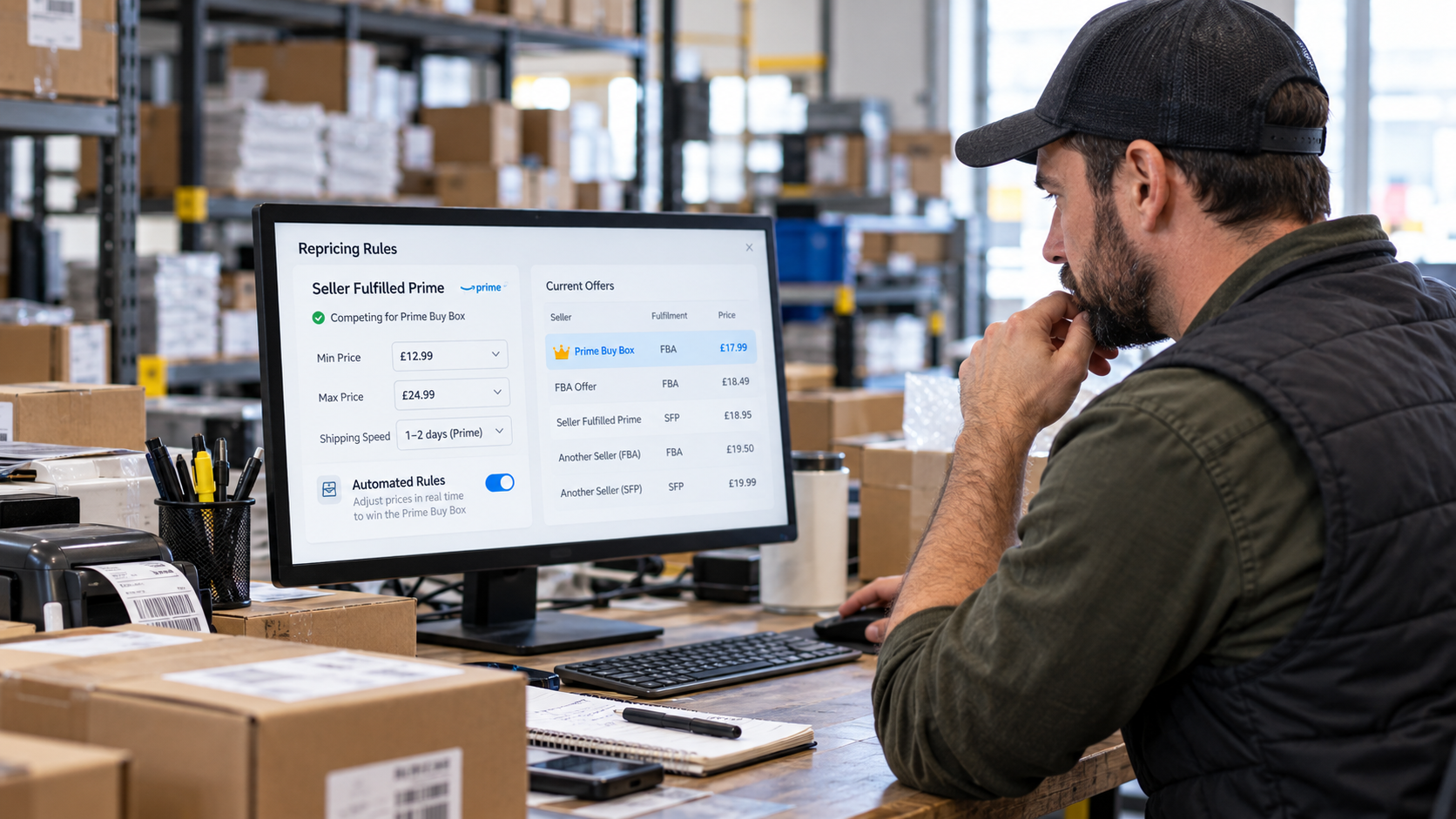
Last verified: September 2026
Seller Fulfilled Prime sellers make the mistake of configuring repricing rules the same way FBA sellers do. The Buy Box algorithm treats their offers differently: FBA gets an implicit fulfillment quality credit that SFP sellers do not, regardless of how reliably they ship. The result is that an SFP offer at exactly the same price as an FBA offer will lose the Buy Box more often than it wins. The fix is not to price lower indefinitely. It is to understand where the algorithm’s tiebreaker kicks in and configure a rule that compensates for it without sacrificing margin unnecessarily.
TL;DR: The Prime Buy Box weights fulfillment reliability. FBA gets that weighting by default. SFP sellers earn it through performance metrics, but must also price more competitively than FBA sellers at equivalent performance levels to win equivalent Buy Box share. The repricing implication is specific: SFP rules need a tighter competitive target than FBA rules on the same ASIN, and the minimum price must be calculated accurately enough that the tighter target does not erode margin.
What Seller Fulfilled Prime is and who qualifies
Seller Fulfilled Prime is Amazon’s program that lets third-party sellers attach the Prime badge to their listings without using FBA, by fulfilling orders themselves to Amazon’s Prime delivery standards. The badge is the point: SFP sellers compete in the Prime Buy Box, not the standard non-Prime Buy Box.
SFP sellers ship from their own warehouses using their own carriers, but commit to meeting Amazon’s delivery speed requirements (including next-day and two-day delivery in the regions they ship to) and maintaining performance metrics that stay within Amazon’s SFP thresholds. Those thresholds cover on-time delivery rate, order defect rate, pre-fulfillment cancellation rate, and valid tracking rate. Amazon publishes current SFP thresholds in Seller Central, and they are worth verifying there before configuring any repricing strategy, as they have been revised previously.
SFP is not the same as standard Merchant Fulfilled (FBM). FBM listings do not carry the Prime badge and compete in a separate Buy Box from Prime-eligible offers. SFP sellers have paid the cost (carrier contracts, warehouse efficiency, staff scheduling) to earn Prime eligibility, and they compete for the same purchase placement as FBA on Prime-eligible listings. The repricing challenge is that the algorithm values FBA’s fulfillment differently from SFP’s, even when SFP performance is strong.
How the Prime Buy Box works differently for SFP vs FBA sellers
The Prime Buy Box algorithm uses fulfillment method as one of its inputs. FBA receives an implicit fulfillment reliability credit that Amazon’s own logistics track record supports. SFP sellers earn Prime eligibility by demonstrating equivalent delivery performance, but they do not receive the same algorithmic weighting as FBA by default.
Amazon’s Buy Box algorithm balances multiple factors: price, fulfillment method, seller performance metrics, shipping speed, and inventory availability. For FBA, fulfillment reliability is assumed: Amazon controls the warehouse, the carrier, and the delivery promise. For SFP, the algorithm evaluates the seller’s actual performance history to make the same reliability judgment. The practical difference is that two offers at identical prices, one FBA and one SFP with strong metrics, will not receive identical Buy Box rotation.
This is not a theoretical disadvantage. SFP sellers with excellent performance histories consistently report winning less Buy Box share than FBA competitors at matching prices. The algorithm is not broken from Amazon’s perspective: it is weighting the certainty of FBA fulfillment more heavily than the track record of any individual SFP seller. The implication for repricing is that matching an FBA offer’s price is not sufficient to compete for equivalent Buy Box time.
Why SFP sellers often need to price lower than FBA competitors on the same ASIN
The fulfillment quality gap between FBA and SFP in the Buy Box algorithm is partially bridgeable through price. SFP sellers who price below the lowest FBA offer move enough of the algorithm’s weighting toward price to compensate for the fulfillment credit differential. The practical outcome is more Buy Box share at a lower price, rather than less Buy Box share at the same price.
The Buy Box is not a winner-take-all mechanism at a single price point. When multiple sellers are in a competitive range, Amazon rotates the Buy Box among eligible sellers based on their weighted algorithm scores. An FBA seller at $29.99 and an SFP seller at $29.99 will both appear in that rotation, but not at equal rates. If the SFP seller prices at $29.49, the price advantage may shift enough weighting to equalize or invert that ratio.
The key point is that “how much lower” is not a fixed number. It depends on the category, the number of competing FBA offers, the SFP seller’s performance score, and the price sensitivity of the specific ASIN. What is consistent across SFP sellers is the direction: competitive parity against FBA requires tighter pricing than competitive parity against other FBA sellers would.
The ceiling on this approach is the minimum price. Pricing below an accurately calculated minimum floor to win more Buy Box share against FBA is a margin problem, not a repricing problem. If the minimum is set correctly (COGS + fulfillment cost divided by 1 minus referral fee percentage minus target margin percentage), the repricing rule can work at the lowest price the business can sustain. If it is not, the rule will find the Buy Box at a loss.
Configuring repricing rules for SFP: the conservative approach
SFP repricing rules should target the lowest FBA offer rather than the lowest overall offer. Competing against FBM or standard seller-fulfilled offers at their prices is unnecessary: those offers are not competing in the same Prime Buy Box. Targeting the lowest FBA offer and pricing slightly below it is the configuration that directly addresses the Buy Box disadvantage.
Step-by-step rule configuration for SFP:
- Set your minimum price first. Before any rule is active, calculate your margin floor: (COGS + fulfillment cost) divided by (1 minus Amazon referral fee percentage minus target margin percentage). For SFP, fulfillment cost includes your carrier rates, warehouse handling, and packing materials. This cost is higher than zero, unlike FBA where Amazon charges the fulfillment fee directly. SFP sellers who calculate minimum price without accurately accounting for their fulfillment cost run rules that appear to protect margin but do not.
- Target the lowest FBA offer, not the lowest overall offer. RepricerExpress rule configuration allows you to set competitive targets relative to FBA offers specifically. Choose this over targeting all offers: FBM offers sit below the Prime Buy Box threshold and competing with them is competing with the wrong benchmark.
- Set your competitive range below the lowest FBA offer. Rather than pricing to match FBA, set a rule that prices 1-3% below the lowest FBA offer as the starting point. This range compensates for the Buy Box weighting differential. If your minimum price prevents you from reaching 1-3% below the lowest FBA offer, your minimum is the floor: the rule holds there and accepts that Buy Box share will be lower at that price level.
- Set a maximum that reflects FBA pricing tolerance. Your maximum can be set at or slightly below the lowest FBA offer on the listing. This prevents your price from rising above the FBA competitive range during periods when fewer FBA sellers are active, which would return the Buy Box weighting disadvantage.
- Review minimum prices before activating. An SFP minimum set too conservatively takes you out of the competitive range. An SFP minimum set too aggressively erodes margin. Because SFP fulfillment costs are variable (carrier rates change, volume changes), review minimum prices on your SFP catalog at least quarterly.
How SFP performance metrics interact with repricing aggressiveness
SFP performance metrics and repricing rules interact in both directions. A rule that wins more Buy Box share generates more orders. More orders require faster fulfillment. Faster fulfillment under higher volume is where SFP performance metrics most often deteriorate. A repricing rule that is too aggressive for your fulfillment capacity is a risk to your SFP eligibility, not only your margin.
Amazon’s SFP performance thresholds cover the metrics that reflect delivery reliability: on-time delivery rate, order defect rate, pre-fulfillment cancellation rate, and valid tracking rate. If any of these fall below the threshold, Amazon can restrict or revoke SFP eligibility. A seller who has lost SFP eligibility has also lost the Prime badge and the Prime Buy Box, which is significantly worse than winning less Buy Box share from conservative pricing.
The practical rule:
Set your repricing aggressiveness relative to your fulfillment capacity ceiling. If your warehouse can fulfill 100 Prime orders per day at Prime standards, and you are currently shipping 60, a tighter competitive rule that increases Buy Box share and volume is appropriate. If you are already at 90, aggressive competitive rules that push volume toward 120 create the risk of late shipments, higher cancellation rates, and metric deterioration.
Monitor your SFP performance metrics in Seller Central on a weekly basis. When any metric trends toward its threshold, the correct response is to make the repricing rule less aggressive, not more: fewer orders at a slightly higher price is the sustainable position while fulfillment capacity catches up.
Performance metrics also affect the algorithm’s weighting of your offer. An SFP seller with consistently strong metrics (on-time delivery well above threshold, ODR near zero) will need to price less aggressively below FBA offers to achieve the same Buy Box share as an SFP seller with metrics near the threshold. Strong performance reduces the Buy Box differential, which means the price gap to FBA that buys equivalent rotation is smaller. This is the correct direction to optimize: improving fulfillment operations reduces the price you have to give away to win the Buy Box.
Key Takeaways
- SFP sellers compete in the Prime Buy Box against FBA sellers, but the algorithm applies a fulfillment quality credit to FBA that SFP must compensate for through price
- Matching the lowest FBA offer price is not sufficient for equivalent Buy Box share: SFP sellers need to price below FBA to move enough algorithmic weighting toward price to offset the fulfillment differential
- The correct benchmark is the lowest FBA offer, not the lowest overall offer: FBM sellers are not in the Prime Buy Box
- Set your minimum price to include your actual SFP fulfillment costs before activating any rule: repricing at a margin floor that does not account for carrier and handling costs produces wins at a loss
- Repricing aggressiveness must be matched to fulfillment capacity: winning more Buy Box share than your warehouse can handle at Prime standards risks metric deterioration and potential SFP eligibility loss
Action Plan
- Calculate your SFP minimum price per ASIN including actual fulfillment cost: (COGS + fulfillment cost) divided by (1 minus referral fee % minus target margin %)
- Configure your RepricerExpress rule to target the lowest FBA offer, not the lowest overall offer
- Set the competitive rule to price 1-3% below the lowest FBA offer, above your minimum floor
- Set maximum price at or slightly below the current lowest FBA offer on each ASIN
- Check your SFP performance metrics in Seller Central before activating; confirm on-time delivery, ODR, cancellation rate, and valid tracking are well above Amazon’s thresholds
- Review both metrics and repricing rules weekly for the first month after activation
Frequently Asked Questions
1. What is Seller Fulfilled Prime?
Seller Fulfilled Prime is an Amazon program that allows third-party sellers to display the Prime badge on their listings while fulfilling orders from their own warehouses rather than Amazon’s FBA network. To qualify, sellers must meet Amazon’s Prime delivery speed commitments (including next-day and two-day delivery) and maintain performance metrics within Amazon’s SFP thresholds for on-time delivery, order defect rate, cancellation rate, and valid tracking. SFP sellers compete in the Prime Buy Box against FBA sellers. Amazon publishes current SFP eligibility requirements in Seller Central.
2. How does SFP repricing differ from FBA repricing?
The core difference is the competitive benchmark and the required price position within it. FBA sellers can price within a range above the lowest offer and still win Buy Box rotation, because FBA’s fulfillment reliability is weighted positively by the algorithm without needing a price offset. SFP sellers need to price closer to or below the lowest FBA offer to achieve equivalent Buy Box share, because the algorithm does not apply the same default fulfillment credit to SFP. SFP repricing rules should target the lowest FBA offer specifically and price below it, rather than matching FBA prices as if the two methods were equivalent.
3. Can SFP sellers win the Buy Box against FBA sellers?
Yes. SFP sellers with strong performance metrics and competitive pricing win the Prime Buy Box against FBA sellers regularly. The key is that they cannot win it at the same price: they need a price advantage to offset the Buy Box algorithm’s default preference for FBA fulfillment. SFP sellers with consistently high on-time delivery rates, low order defect rates, and reliable tracking need a smaller price gap to win equivalent Buy Box share compared to SFP sellers with metrics near their thresholds. Improving fulfillment operations and maintaining strong metrics reduces the price difference required to compete with FBA.
4. How do I set up repricing rules for Seller Fulfilled Prime?
Set your minimum price first using your actual SFP fulfillment costs: (COGS + fulfillment cost) divided by (1 minus referral fee percentage minus target margin percentage). Then configure a RepricerExpress rule to target the lowest FBA offer, not all offers: FBM listings are not in the Prime Buy Box and competing with them sets the wrong benchmark. Set the competitive range to 1-3% below the lowest FBA offer, bounded below by your minimum. Set the maximum at or near the lowest FBA offer to prevent your price from drifting above the competitive range during low-competition periods. Check your SFP performance metrics in Seller Central before activating: the rule will drive more orders, and your fulfillment operation needs to handle the increase without letting metrics deteriorate toward Amazon’s thresholds.
See it in action: book a free demo at repricerexpress.com/book-demo-2/.