Last verified: September 2026
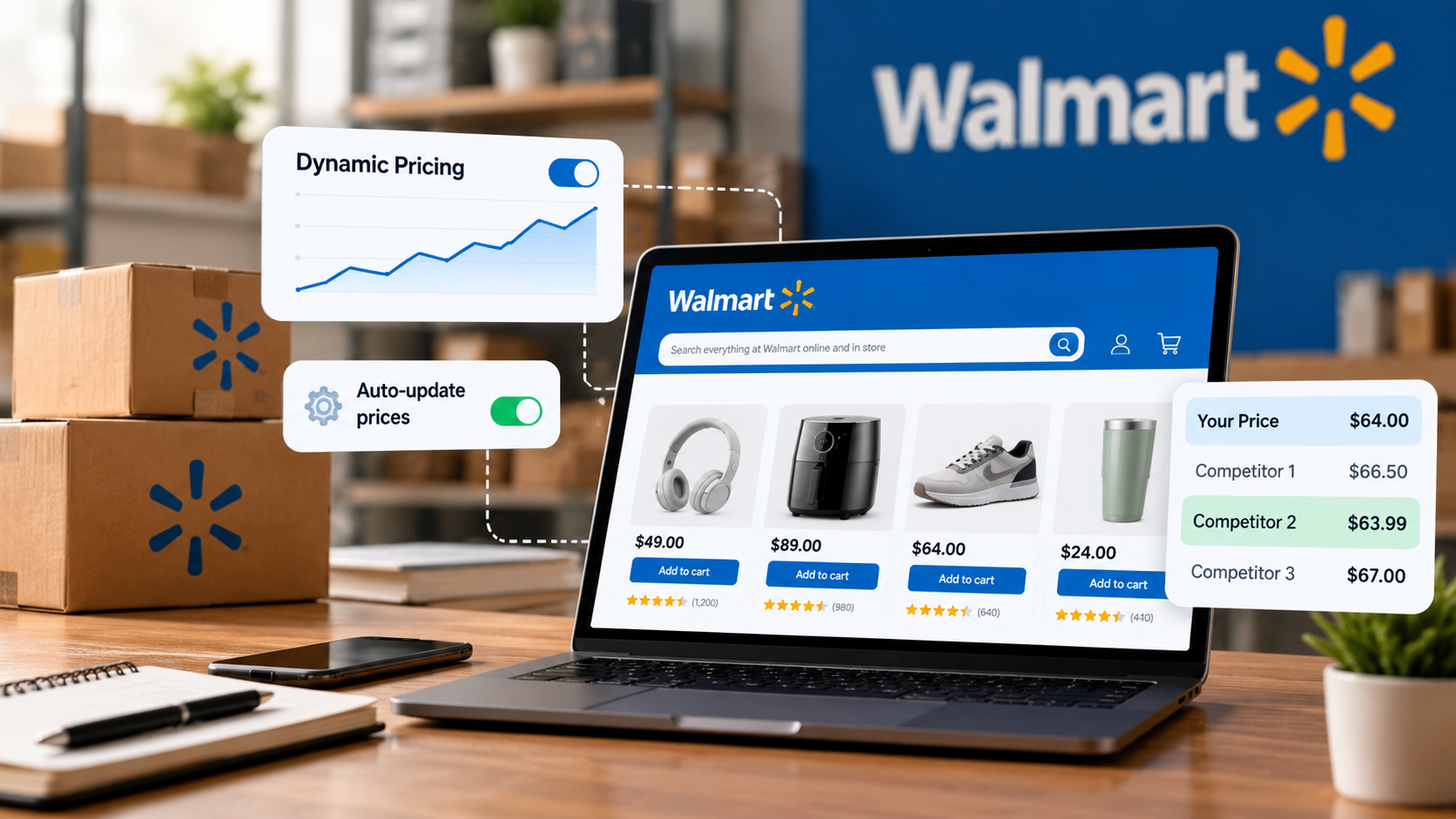
Walmart dynamic pricing is the practice of adjusting your product prices automatically in response to competitor price changes on Walmart.com, with the goal of keeping your offer within Walmart’s competitive window and winning Buy Box rotation. Unlike manual price management, dynamic pricing tools monitor competitor prices continuously and apply your repricing rules without human intervention.
TL;DR: Walmart’s Buy Box requires a price within approximately 3% of the lowest offer on a listing (Maxmerce, December 2025). Dynamic pricing tools monitor competitor prices and hold your offer within that window automatically. On Walmart, competitive pricing also affects search ranking: the Polaris algorithm factors in price as an offer quality signal alongside listing content and seller performance. Sellers who reprice manually cannot maintain consistent competitive positioning across a full catalog.
What dynamic pricing means in the Walmart Marketplace context
Dynamic pricing on Walmart means your prices respond to market conditions automatically, not on a manual review schedule. A repricing tool monitors the offers competing with yours on each Walmart listing and adjusts your price to stay within your defined competitive range, above the minimum price floor you set.
On Walmart’s marketplace, most products have shared listings: multiple sellers compete for the same item detail page. The seller who wins the Buy Box gets the primary purchase placement. Dynamic pricing is what keeps your offer competitive in that shared listing environment without someone checking prices manually.
Walmart’s pricing environment moves faster than most sellers expect. Competitor prices shift multiple times per day in active categories. A price competitive at 9am may sit outside the eligibility window by noon. Dynamic pricing tools close that gap by monitoring continuously and adjusting immediately when the competitive window moves.
How Walmart dynamic pricing differs from Amazon repricing
Walmart and Amazon shared listings run on different rules. Three differences matter most for sellers running repricing tools across both platforms: the Price Parity Rule, the competitive window, and how price feeds into search ranking.
1. The Price Parity Rule
Walmart requires that your price on Walmart.com does not exceed your price on other channels, including Amazon. If your Amazon price for an item is $24.99, your Walmart price cannot go above $24.99 without risking Buy Box suppression. Your Walmart dynamic pricing maximum must be set at or below your Amazon minimum per SKU. Repricing tools that manage both marketplaces independently (without cross-platform coordination) can trigger this rule inadvertently.
2. The competitive window
Walmart’s competitive pricing threshold is approximately 3% above the lowest offer on the listing (Maxmerce, December 2025). Amazon’s window is more flexible: FBA sellers can price above the lowest FBM offer and still win the Buy Box because the algorithm weights fulfillment quality heavily. Walmart’s Polaris algorithm is less forgiving of price gaps; the 3% threshold applies regardless of fulfillment method, though WFS enrollment provides a ranking and Buy Box advantage on top of competitive pricing.
3. Price as a search ranking signal
On Amazon, competitive pricing primarily affects Buy Box eligibility and conversion rate. On Walmart, price competitiveness is also an input into Polaris search ranking: an offer priced outside the competitive window loses search placement alongside Buy Box eligibility. Dynamic pricing therefore affects Walmart search visibility, not just Buy Box share.
The competitive price window: Walmart’s key pricing mechanism
Stay within approximately 3% of the lowest offer and you are eligible for Buy Box rotation. Drift above it and you lose Buy Box share and search placement simultaneously. That 3% window is the mechanism Walmart dynamic pricing is built around (Maxmerce, December 2025).
The window floor moves with competitor prices. When a competitor lowers their price, your eligibility window shifts down with it. When they raise theirs or go out of stock, the window widens and your price can rise within your maximum. Dynamic pricing tools track those movements and keep your price in range without manual checks.
How RepricerExpress automates Walmart dynamic pricing
RepricerExpress Walmart repricing monitors competitor prices across your Walmart catalog and applies your competitive rules automatically, within the minimum and maximum prices you set. You define the guardrails; RepricerExpress keeps your price within the competitive window inside them.
The configuration is rule-based. Set your minimum price, calculated from your cost, fulfillment, and target margin, and your maximum price, respecting the Price Parity Rule. Choose how you want to position within the range. RepricerExpress handles the monitoring and price adjustment from there, across your full Walmart catalog.
For WFS-enrolled listings, the competitive target is typically 2-3% of the lowest offer: WFS enrollment provides a fulfillment quality signal that tolerates a small price premium while maintaining Buy Box eligibility. For seller-fulfilled listings, target 1-2%.
Getting started with Walmart dynamic pricing rules
The minimum price is the prerequisite. Set it wrong and dynamic pricing reduces your margin with every reprice. The formula: (COGS + fulfillment cost) divided by (1 minus referral fee % minus target margin %). A full worked example is in the Walmart Buy Box repricing guide.
Once minimums are set per listing:
- Set your Walmart maximum at or below your Amazon minimum for the same SKU
- Choose your competitive rule: 1-2% of the lowest offer for seller-fulfilled, 2-3% for WFS
- Activate in RepricerExpress and allow 72-96 hours before evaluating performance
- Monitor Buy Box win rate in Seller Center alongside search position; both should improve once your offers are inside the competitive window
Key Takeaways
- Walmart dynamic pricing keeps your offer inside the ~3% Buy Box window by monitoring competitor prices and adjusting automatically (Maxmerce, December 2025)
- Three differences from Amazon repricing: the Price Parity Rule (Walmart price cannot exceed your Amazon price per SKU), a tighter ~3% competitive window, and price as a direct Polaris search ranking signal
- Your dynamic pricing maximum must be set at or below your Amazon minimum for each SKU: not doing this risks Buy Box suppression under the Price Parity Rule
- RepricerExpress applies competitive rules within your price guardrails; set the minimum and maximum correctly before activating
Action Plan
- Calculate your minimum price per Walmart listing: (COGS + fulfillment cost) divided by (1 minus referral fee % minus target margin %)
- Check your current Amazon minimum price per SKU and set your Walmart maximum at or below it
- Configure your competitive rule in RepricerExpress: 1-2% for seller-fulfilled, 2-3% for WFS listings
- Activate and allow 72-96 hours, then check Buy Box win rate and search position together in Seller Center
Frequently Asked Questions
1. What is Walmart dynamic pricing?
Walmart dynamic pricing is the automated adjustment of your product prices in response to competitor price changes on Walmart.com. A repricing tool monitors competing offers on each of your listings and moves your price to stay within the competitive window (approximately 3% above the lowest offer) without manual price checks. The result is consistent Buy Box eligibility and the search placement that comes with it, maintained across your full catalog without a daily review.
2. How does Walmart dynamic pricing work for third-party sellers?
A dynamic pricing tool watches the competing offers on each of your Walmart listings and adjusts your price within your defined minimum and maximum to stay competitive. When a competitor lowers their price, your tool responds to maintain the competitive gap. When they raise their price or go out of stock, your price can move up within your maximum. The repricing runs continuously, which is what makes it effective in categories where competitor prices shift multiple times per day.
3. Is dynamic pricing the same on Walmart and Amazon?
No. The mechanisms are similar but the rules differ in three ways: Walmart’s Price Parity Rule requires that your Walmart price does not exceed your price on other channels including Amazon; Walmart’s competitive window is approximately 3% (tighter than Amazon’s, which allows more flexibility for FBA sellers); and on Walmart, price competitiveness is a search ranking signal through the Polaris algorithm, so pricing outside the window affects both Buy Box eligibility and search visibility simultaneously.
4. How do I set up dynamic pricing for Walmart?
Calculate your minimum price per listing from your cost, fulfillment, Walmart referral fee, and target margin. Set your maximum price at or below your Amazon minimum for the same SKU. Choose a competitive rule in RepricerExpress: 1-2% of the lowest offer for seller-fulfilled listings, 2-3% for WFS, and activate it. Allow 72-96 hours, then check Buy Box win rate in Seller Center alongside search position. Both should improve once your offers are inside the competitive window consistently.
See it in action: book a free demo at repricerexpress.com/book-demo-2/.