Last verified: October 2026
MAP-restricted resellers face a specific repricing problem that sellers without brand agreements do not have: the floor on their price is not only their cost. It is a contractual commitment to a supplier. One aggressive competitor repricing below MAP does not give you permission to match. It gives you a compliance risk. The right tool setup closes that gap automatically.
TL;DR: If you are an authorized dealer selling MAP-restricted products on Amazon, your repricer’s minimum price setting is your MAP compliance mechanism. Set your minimum to match the MAP price for each SKU and your repricer cannot go below MAP regardless of competitive pressure, competitor pricing, or market conditions. The protection is automatic once the minimum is configured correctly. This article explains the setup, the edge cases, and the right response when a competitor drops below your MAP floor.**
What MAP is and how brand suppliers enforce it on Amazon
MAP (Minimum Advertised Price) is a supplier-set policy that defines the lowest price an authorized dealer may display publicly for a brand’s product. It is a contractual agreement, not a legal requirement, and the brand enforces it, not Amazon.
A few things MAP is not:
- MAP is not the same as MSRP (Manufacturer’s Suggested Retail Price). MSRP is a recommendation; MAP is a floor.
- MAP is not enforced by Amazon as a platform rule. Amazon has its own fair pricing policy, but that policy is about Amazon’s assessment of your pricing relative to other channels, not about enforcing a brand’s MAP agreement with you.
- MAP is not a resale price. In most regions, brands can legally set MAP for advertised prices; they cannot legally dictate the price you charge at checkout. On Amazon, the listing price that appears on the product detail page is treated as the advertised price for MAP purposes.
Brand suppliers typically communicate MAP prices through a written policy document you sign when you join their authorized dealer program, or through periodic MAP price lists sent by email. Enforcement is done by the brand, typically through price monitoring software that tracks listed prices across marketplaces. The brand contacts you if your listing drops below MAP. Repeat violations escalate from warning to supply suspension to loss of authorized dealer status.
Understanding how repricing interacts with the mechanics of price competition is covered in the guide to how Amazon repricing works.
Why MAP compliance matters for authorized dealers: the consequences of violations
The immediate risk of a MAP violation is not a platform penalty from Amazon. It is a supply chain consequence from your brand partner. Most brands that discover a MAP violation start with a warning, escalate to a temporary supply hold, and terminate the dealer relationship for repeat offenders.
The consequences in practice:
Loss of authorized dealer status. This is the terminal outcome for serial MAP violators. If you are removed from a brand’s authorized dealer program, you lose access to their wholesale supply chain, their co-op advertising support, and in some cases your right to list as an “authorized dealer” in your Amazon store front. Buyers who want confidence in product authenticity and warranty support specifically filter for authorized dealers, particularly in categories like electronics, outdoor gear, and personal care.
Supply suspension. A temporary hold on orders is the common warning-phase response. If you depend on that brand for a meaningful share of your catalog revenue, even a two-week hold creates inventory gaps that compound into lost sales and Buy Box losses across your account.
Account-level risk. Amazon does not directly enforce brand MAP policies, but brands can report consistent pricing violations. In some cases, brands have used Amazon’s intellectual property and counterfeit reporting channels in aggressive MAP enforcement disputes. The exposure varies by brand and category, but it is a risk that exists independently of your product’s actual authenticity.
Relationship damage. Authorized dealer programs often come with margin protections, co-op funding, preferred access to new product launches, and seasonal allocation priority. Violating MAP puts all of that at risk, not only your supply of the specific product.
The Buy Box algorithm also considers pricing health as part of seller performance evaluation. Detailed analysis of those factors is in the Buy Box formula breakdown.
How your repricing minimum price becomes your MAP enforcement mechanism
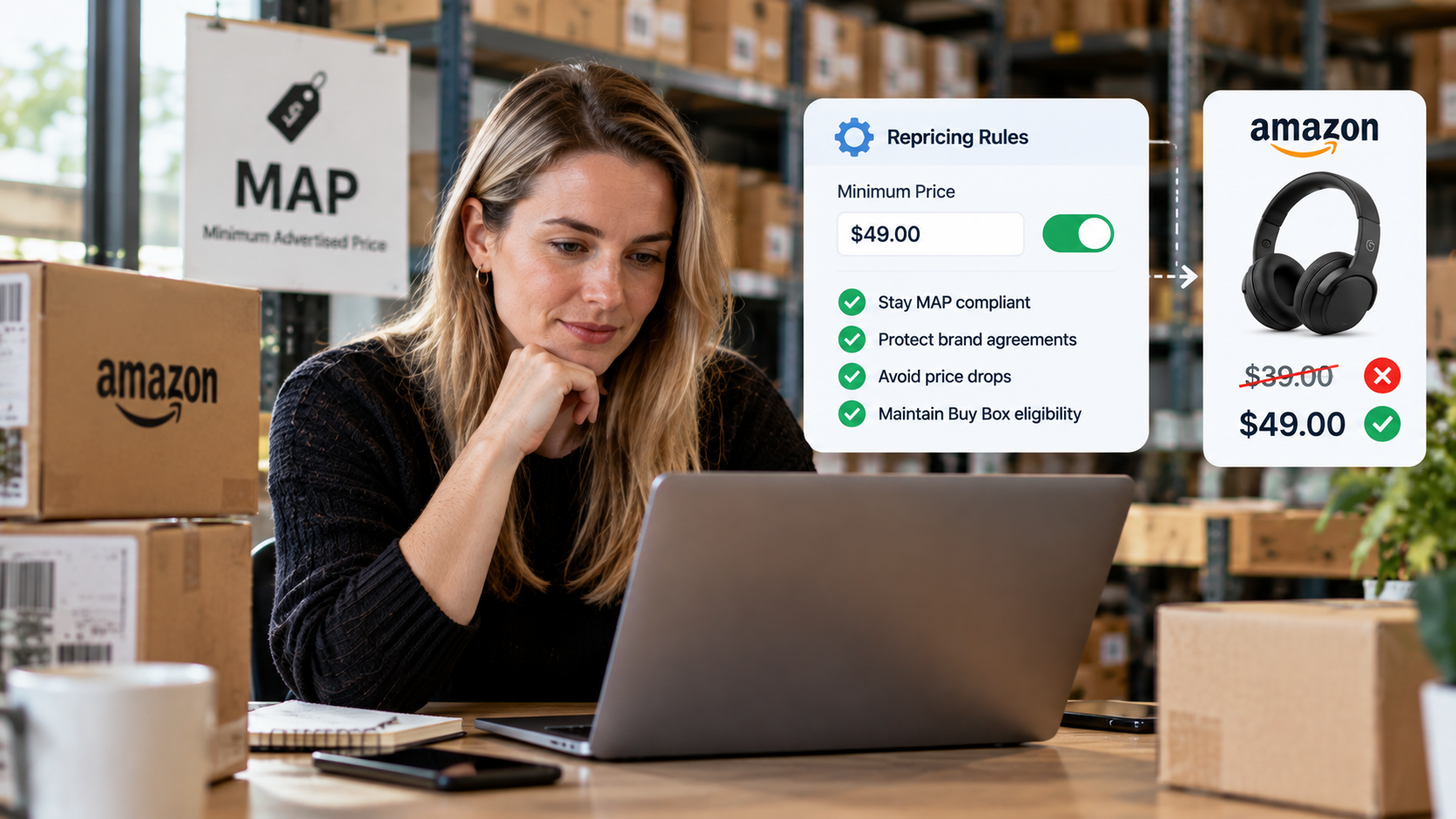
The repricer minimum price is the lowest price your listing can be set to, regardless of what any rule or competitive trigger would otherwise produce. Set it to MAP, and MAP compliance is automatic.
This is the central point of this article. Most sellers who use a repricer think of the minimum price as a cost protection floor: “don’t sell below my COGS.” That is a valid use, but for MAP-restricted sellers the minimum price serves a second, more important function: it is the hard stop on the downward price movement that would violate a brand agreement.
How it works:
- You receive MAP prices from your brand supplier, either as a standard policy or as a periodic price list update.
- You set the minimum price in RepricerExpress to the MAP price for each affected SKU.
- Your repricing rule continues to compete normally within the range above MAP. It can match competitors, target a percentage above the lowest price, or target the Buy Box, according to your strategy.
- The minimum price blocks any rule output that would fall below MAP. The repricer cannot produce a price below the floor you set.
The result: you are protected from MAP violations automatically, even in competitive conditions where a rule would otherwise try to undercut a below-MAP competitor. Your rule fires, calculates the competitive price, sees that it is below the minimum, and holds at the minimum instead. No manual override needed.
This is also true in high-velocity selling scenarios. When the Buy Box is contested and prices are moving quickly, manual MAP monitoring is impossible. A repricer minimum is not. It operates at the same speed as the repricing cycle itself.
One important nuance: your MAP compliance floor is only as accurate as the minimum prices you have entered. If a brand issues a MAP price increase and you do not update your minimum, you can still drift into violation even with a repricer in place. The automation protects against competitive downward pressure; it does not automatically track MAP policy changes. That tracking is still your responsibility.
The rule types available in RepricerExpress that interact with the minimum price setting are covered in the guide to advanced FBA repricing rules.
Setting minimum prices across large MAP-restricted catalogs efficiently
For a catalog of ten MAP-restricted SKUs, setting minimums individually is straightforward. For a catalog of several hundred, you need a systematic approach or the setup becomes a maintenance burden.
Organize your MAP catalog by brand and by MAP review frequency. Some brands issue quarterly MAP updates; others update monthly or in response to wholesale price changes. Group your MAP-restricted SKUs by supplier so you can update them as a batch when a new MAP price list arrives, rather than hunting through a mixed catalog.
Map your supplier’s MAP list to your repricer’s SKU field. Your supplier’s MAP list will use their product codes (UPC, EAN, brand SKU). Your repricer uses Amazon ASINs or merchant SKUs. Build a cross-reference table that maps each supplier code to the corresponding ASIN in your catalog. This is a one-time setup cost that makes every future MAP update a bulk operation rather than a SKU-by-SKU search.
Use bulk upload where available. RepricerExpress supports minimum price updates via bulk upload. Once your cross-reference table is built, applying a new MAP price list becomes: receive the list, update the minimum column in your import file, upload. The alternative (editing minimums one by one in the interface) is viable for small catalogs but does not scale.
Set a MAP update calendar. When you onboard a new brand, note their MAP review schedule and add it to your operations calendar. Even if the supplier does not proactively remind you, checking for MAP list updates on a known cycle prevents the scenario where you are operating on a six-month-old MAP list while the brand has already increased prices.
Treat seasonal MAP changes as a standing item in your repricing review. Many brands issue revised MAP lists for Q4 or around major promotional periods. If you are enrolled in holiday MAP programs that allow promotional pricing below standard MAP during specific windows, you need a process to apply and then revert those temporary minimums at the right time.
What happens when a competitor violates MAP, and what to do about it
When a competitor lists below MAP, your minimum price holds you at MAP regardless. Your Buy Box share may fall in the short term. The right response is to hold, document, and report, not to match.
This is the most common compliance pressure point for MAP-restricted sellers. A competitor (authorized dealer or not) lists a product at $34.99 when MAP is $39.99. The Buy Box window shifts. Your listing at MAP loses Buy Box share. Sales slow.
The natural instinct is to match the competitor. That is the wrong response, for two reasons:
First, if you are an authorized dealer and the competitor is not, you are the one with something to lose. Matching a non-authorized seller’s below-MAP price to win back Buy Box share is still a MAP violation on your end. Your brand agreement does not include an exception for competitive parity with grey-market sellers.
Second, the competitor’s below-MAP position may be short-lived. Brands actively monitor their MAP-restricted ASINs. A price drop to $34.99 on a product with a $39.99 MAP will typically trigger a monitoring alert at the brand within hours on well-monitored categories. The violator gets a warning or a supply cut. The violation clears. If you held MAP throughout, your listing is correctly positioned and you recapture Buy Box share as the market normalizes.
What to do when a competitor goes below MAP:
- Document the violation with a screenshot, the ASIN, the listing price, and the date.
- Report the violation to your brand contact or through the brand’s MAP violation reporting channel. Brands want to know. They are protecting the value of their authorized network.
- Hold your minimum price at MAP. Do not match.
- Check whether the competitor is an authorized dealer. Brand-authorized sellers should also be following MAP; non-authorized sellers are a separate problem for the brand to handle.
Your Buy Box positioning during a period when a below-MAP competitor holds the Buy Box is covered by the factors that Amazon weights beyond price. The guide to winning the Amazon Buy Box explains what those factors are and how to maintain your position on them.
One outcome to watch for: Amazon’s fair pricing policy. If below-MAP pricing becomes the prevailing market price on an ASIN for an extended period, Amazon may suppress the Buy Box on that listing entirely (no seller wins it) because the lowest price visible on the platform is significantly below the typical price on other channels. That suppression harms every seller on the listing, including you. It is another reason to report violations quickly so they are resolved before they affect the listing’s overall Buy Box health.
The relationship between price, seller performance metrics, and Buy Box eligibility is covered in the guide to Buy Box placement factors.
Key Takeaways
- MAP (Minimum Advertised Price) is a supplier policy, not a law. Your brand enforces it, not Amazon. Violations are handled through supply consequences, not Amazon penalties.
- The repricer minimum price is the MAP compliance mechanism. Set it to MAP and the repricer cannot go below MAP regardless of competitive pressure or rule output.
- Automation protects you from competitive downward pressure. It does not track MAP policy changes from your supplier. Updating your minimums when MAP price lists are revised is still a manual step.
- For large MAP-restricted catalogs, build a supplier code-to-ASIN cross-reference table once and use bulk upload for every subsequent MAP update. Managing hundreds of minimums SKU-by-SKU does not scale.
- When a competitor violates MAP, hold your minimum and report to the brand. Matching a below-MAP price to recover Buy Box share is still a violation on your end, regardless of what the competitor is doing.
- MAP violations by other sellers create short-term Buy Box share pressure for compliant dealers. They often resolve quickly once the brand’s monitoring system catches them.
Action Plan
- Pull your current list of MAP-restricted ASINs from your brand supplier’s most recent MAP price list. If you do not have a current list, contact each supplier’s account manager and request one.
- Build a cross-reference table: supplier product code in column A, Amazon ASIN in column B, MAP price in column C. Save this as your MAP master reference file.
- Log in to RepricerExpress and review the minimum price currently set for each MAP-restricted ASIN. Compare it against column C of your reference file. Identify any discrepancies.
- Update minimum prices to match MAP for any SKU where the current minimum is below MAP, above MAP, or missing.
- Use bulk upload if your catalog has more than 20 MAP-restricted SKUs. Manually update if it is smaller.
- Add a recurring calendar item for each supplier’s MAP review cycle. Note the review date and the last time you updated minimums from that supplier.
- Add a MAP violation reporting step to your marketplace management routine. When you identify a below-MAP competitor, document and report within 24 hours rather than queuing it as a task.
- Review your repricing rules to confirm that your maximum price is set correctly above MAP and that no rule has a minimum override that could conflict with your MAP floor.
Frequently Asked Questions
1. What is MAP pricing on Amazon?
MAP (Minimum Advertised Price) is a price floor set by a brand supplier that authorized dealers agree to maintain on their public listings. On Amazon, the price displayed on the product detail page is treated as the advertised price, so MAP applies to the listed price shown to shoppers. MAP is a contractual agreement between the brand and each authorized dealer, not a rule imposed by Amazon. The brand monitors compliance and enforces the policy through supply consequences, not through Amazon’s platform systems.
2. How do I comply with MAP requirements using a repricer?
Set your repricer’s minimum price to the MAP price for each affected SKU. Once the minimum is correctly set, your repricing rules can compete freely within the range from MAP up to your maximum price. The repricer minimum acts as a hard floor: any rule output that falls below MAP will be overridden and held at the minimum instead. This makes MAP compliance automatic and continuous, including during active competitive price movements when manual monitoring is not feasible. The one step that remains manual is updating your minimums when the brand issues a new MAP price list.
3. Can a repricer automatically enforce MAP pricing?
A repricer can automatically prevent your listing price from going below MAP, but only if your minimum price is set to MAP and kept current with the brand’s price list. The automation handles the downward pressure from competitive repricing. It does not pull MAP updates from your supplier automatically or alert you when the brand changes their MAP prices. Systematic MAP compliance requires both the repricer automation and a process for applying supplier price list updates to your minimum prices on a regular cycle.
4. What happens if I violate MAP on Amazon?
MAP violations are handled by the brand supplier, not by Amazon directly. The typical escalation path begins with a written warning from the brand, followed by a temporary supply suspension for repeat violations, and ultimately loss of authorized dealer status for persistent non-compliance. Amazon does not enforce brand MAP policies as part of its standard platform rules, though Amazon has its own fair pricing policy that addresses cases where an item’s listed price is significantly higher than prices on other channels. If MAP violations become widespread on an ASIN, Amazon may suppress the Buy Box on that listing, which affects every seller including compliant ones.
See it in action: book a free demo