Last verified: October 2026
Most repricing guides teach you to beat the competition on price. For wholesale sellers competing on authorized brand ASINs, that advice leads directly to a margin-destroying price spiral. When you and four other authorized dealers all bought from the same distributor at roughly the same price, undercutting each other by $0.01 at a time achieves nothing except lower margins for all of you. The correct repricing strategy for wholesale is rotation maintenance, not price aggression. The rule configuration that supports it looks markedly different from what most sellers run.
TL;DR: Wholesale sellers competing on brand ASINs alongside other authorized dealers face a different repricing problem than OA or private label sellers. Your costs are similar to your competitors. Pure price competition destroys margin for everyone. The correct strategy is Buy Box rotation, not Buy Box domination: stay within the competitive price window, let Amazon’s algorithm distribute the Buy Box among eligible sellers, and win rotation share through seller metrics rather than by undercutting. This article covers how to configure RepricerExpress to execute that strategy.
Why wholesale repricing is different from arbitrage repricing
The pricing problem for wholesale sellers is not COGS variability: it is competitive parity. Every authorized dealer bought from the same manufacturer or distributor, at similar prices, under similar terms.
Online arbitrage sellers reprice against variable costs. Their COGS changes with every sourcing event, and their repricing minimum reflects that variability. The challenge for an OA seller is calculating a different minimum for each purchase lot.
Wholesale sellers face the opposite situation. Your COGS is fixed and predictable. So is your competitor’s. You both paid roughly the same for the same ASIN. You both have similar FBA fees. You are both authorized by the same brand. And you are both listed on the same product detail page.
In that environment, a “beat the lowest price by $0.01” repricing strategy does not win sales. It only moves the price floor down one cent at a time until everyone’s margin is gone. The seller who triggers that cycle gains nothing, and every other authorized dealer loses margin alongside them.
Understanding why wholesale repricing needs a different approach requires understanding how the Buy Box distributes among similar sellers. For the mechanics of how repricing works across the marketplace, see our guide to how Amazon repricing works.
The authorized dealer landscape: competing when everyone has similar landed costs
Amazon’s Buy Box algorithm does not simply award the Buy Box to the cheapest seller. Among sellers with competitive prices and good metrics, it rotates.
When you are one of several authorized dealers on a brand ASIN, several dynamics apply simultaneously:
Similar cost structure across all sellers. Wholesale pricing is set by the manufacturer or distributor. Authorized dealers buying at the same wholesale price have the same cost floor. Slight differences come from volume tiers, shipping terms, or payment terms, but the spread is usually much smaller than in OA, where one seller might have paid $9.00 and another $13.50 for the same ASIN.
Brand-authorized pricing expectations. Most established brands require authorized dealers to maintain pricing above a set minimum (MAP; see Section 4). When all authorized sellers respect MAP, no one can profitably undercut below that floor without violating their dealer agreement.
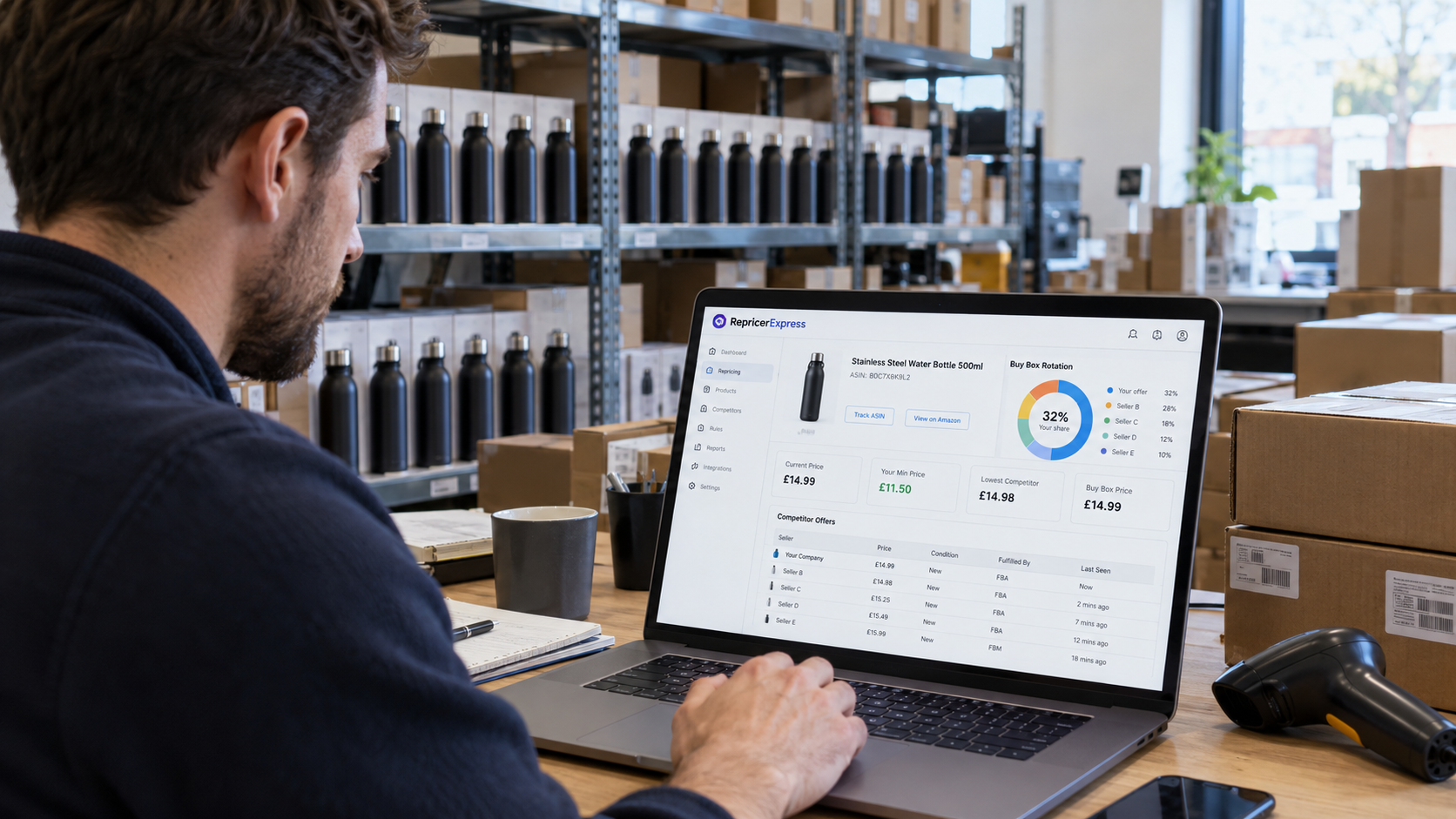
Amazon’s rotation mechanism. When multiple FBA sellers are within a competitive price band on the same ASIN, Amazon distributes Buy Box time among them. The seller with the lowest price does not get 100% of Buy Box time; they get a higher share, but other competitive sellers receive rotation too. The exact split depends on price proximity, seller metrics, and inventory levels.
Fulfillment method matters. FBA sellers have a structural advantage over FBM sellers for Buy Box eligibility, even when FBM sellers price lower. Amazon’s algorithm accounts for shipping speed and reliability. A wholesale seller using FBA competes for Buy Box share in a different pool from FBM sellers. You generally do not need to match an FBM seller’s lower price to maintain your Buy Box rotation.
The practical implication: the goal for a wholesale seller is not to win the Buy Box outright by being cheapest. The goal is to stay within the competitive price band so Amazon’s algorithm includes you in rotation. For a complete view of what factors Amazon weighs in Buy Box allocation, see our guide to the Buy Box placement factors.
Buy Box rotation strategy for wholesale: staying in rotation without racing to the bottom
The wholesale repricing strategy that protects margin is rotation maintenance, not price leadership. You want to stay within the Buy Box price window, not necessarily hold the lowest price.
Amazon does not publish the exact Buy Box threshold, but the practical range for most categories is that sellers priced within roughly 2-5% of the lowest eligible FBA offer are included in rotation. Outside that range, you lose Buy Box eligibility and your sales drop sharply. Inside that range, your share of Buy Box time depends on your seller metrics, not your price alone.
This changes the repricing objective:
Old framing (wrong for wholesale): “Beat the lowest price so I get the Buy Box.”
Correct framing for wholesale: “Stay within the Buy Box price window so I get rotation share. Win more rotation through strong seller metrics, not through price cuts.”
What drives rotation share when prices are competitive:
- Order defect rate (ODR): sellers with lower ODR typically receive more Buy Box time
- Shipping speed: FBA sellers are inherently faster than most FBM sellers; within FBA, standard processing time is equal
- Seller feedback score: higher feedback ratings correlate with more Buy Box allocation
- In-stock percentage: a seller who frequently goes out of stock loses Buy Box share to those who maintain consistent inventory
The practical target for your maximum price: Set your maximum at a price where your margin is healthy. Set your competitive rule to match the lowest eligible FBA offer (not undercut it). When the Buy Box price rises (e.g., when a competitor runs out of stock and drops from the listing), your maximum allows you to capture that upside rather than staying pinned to a lower price unnecessarily.
For a detailed view of the Buy Box factors that determine rotation, see the Buy Box formula breakdown on this site.
How MAP restrictions interact with your repricing minimum
MAP (Minimum Advertised Price) is a brand-imposed floor on the price at which authorized dealers can list and sell a product. Your RepricerExpress minimum price should be set at or above MAP. Never go below.
MAP policies exist to protect brand value and prevent price erosion across authorized channels. A brand that allows its products to be sold at deeply discounted prices risks devaluing the product in consumers’ eyes and undermining authorized dealers who hold inventory at full cost.
Amazon does not enforce MAP on behalf of brands. The platform allows sellers to list below MAP. However, an authorized dealer who violates MAP terms risks having their dealer agreement terminated, losing access to the brand’s inventory, and potentially having their listing removed if the brand files a complaint.
What MAP means for your repricing minimum:
Your minimum price in RepricerExpress is not the same as MAP, but it should never go below MAP if you have a MAP agreement in place. Set your minimum at MAP, or at your own margin floor if that figure is higher than MAP.
The typical MAP scenario in wholesale repricing:
When all authorized dealers hold at or above MAP, the Buy Box rotates among them based on seller metrics. No one can profitably undercut the floor. The competitive advantage for individual dealers comes from their fulfillment reliability, feedback scores, and inventory consistency, not from pricing.
The rogue seller scenario:
At some point, a non-authorized seller or a gray market reseller will undercut MAP on your ASIN. Your correct response is not to match their price. Matching a rogue seller below MAP violates your own dealer agreement and triggers a race to the bottom that benefits no one except the rogue seller, who has no authorized relationship to protect.
The correct response: hold at MAP. Report the violation to the brand. Many brands have brand registry and enforcement processes that can remove unauthorized sellers within days or weeks. In the interim, your Buy Box win rate will drop while the rogue seller undercuts. Holding MAP protects your margin and your supplier relationship.
If your minimum price in RepricerExpress is correctly set at MAP, the repricer will not chase the rogue seller below your floor. This is one of the most important guardrails in wholesale repricing, and most sellers who fail to configure it correctly end up repricing below MAP during competitive periods without realizing it.
Rule configurations that maintain margin while competing on authorized brand ASINs
The rule architecture for wholesale repricing is simpler than for OA or private label, but the details matter. The wrong configuration turns a rotation strategy into a price war.
Minimum price: at MAP (or margin floor, whichever is higher)
Set your minimum to MAP. Do not set it below MAP even when competitors are underpricing. Your repricer should hold you above the floor regardless of competitive pressure. If you have multiple brands at different MAP levels, you may need separate rules or ASIN-level minimum overrides.
Maximum price: at your target margin ceiling
Your maximum should reflect the highest price at which you would realistically make a sale on this ASIN. For most wholesale categories, this is MAP plus 10-20%, though it varies significantly by category and demand seasonality. Set a higher maximum than you think you need. When competitors go out of stock and the Buy Box price rises, you want your rule to follow the price up rather than cap your earnings unnecessarily.
Competitive rule: match the lowest eligible FBA offer, not beat by $0.01
This is the critical difference from OA or RA repricing rules. Matching the lowest eligible FBA offer keeps you in the competitive price window without pushing the price lower. If you are already at the lowest eligible FBA offer, matching yourself changes nothing. If a competitor drops below you, the rule moves you to match, but no lower.
Do not use “beat lowest by $0.01” as your primary rule on shared brand ASINs. That rule works in environments where you need to win the Buy Box outright (e.g., private label, where you are the only seller). On a shared ASIN with multiple authorized dealers, it initiates the price spiral that harms everyone.
FBA vs FBM handling: price separately
If your rule set includes FBM sellers, configure RepricerExpress to match against FBA sellers only. FBM sellers pricing below you on the same ASIN do not necessarily win the Buy Box. Amazon penalizes slower shipping in its allocation. You should not chase an FBM price to stay competitive. When the rule targets FBA only, you price relative to the sellers competing with you for Buy Box time.
Inventory trigger: build a low-stock rule
When you are running low on an ASIN, your likelihood of winning ongoing Buy Box time decreases. A low-inventory rule that raises your price as units drop below a threshold (e.g., fewer than 5 units remaining) lets you capture additional margin from the remaining stock rather than continuing to compete aggressively for rotation share you cannot sustain.
For the full range of rule types available in RepricerExpress and how to structure them across a catalog, see the guide to winning the Amazon Buy Box and the guide to advanced FBA repricing rules.
Key Takeaways
- Wholesale repricing operates on shared brand ASINs where all authorized dealers have similar landed costs. The strategic objective is rotation maintenance, not price leadership.
- Amazon’s Buy Box algorithm rotates among sellers within a competitive price band (roughly 2-5% of the lowest eligible FBA offer for most categories). You do not need to hold the lowest price to win Buy Box time.
- FBA sellers compete in a different pool from FBM sellers. Do not price against FBM listings to win rotation. Amazon already accounts for fulfillment quality in its Buy Box allocation.
- MAP is your repricing minimum. Set your RepricerExpress minimum at MAP. Never configure a rule that allows the repricer to go below MAP, even when competitors are doing so.
- When a rogue seller undercuts MAP: hold your minimum, do not match, report the violation to the brand. Your dealer agreement and supplier relationship are worth more than short-term Buy Box share.
- Use “match lowest eligible FBA offer” as your competitive rule on shared brand ASINs. “Beat by $0.01” triggers a price spiral that costs all authorized dealers margin without delivering a meaningful sales advantage to any of them.
Action Plan
- Identify the brand ASINs in your catalog where you compete against other authorized dealers. These need wholesale-specific rule configurations, separate from any private label or OA rules you run.
- Confirm your MAP level for each brand you carry. Your RepricerExpress minimum for those ASINs must be set at MAP. Check whether current minimums are at, above, or (critically) below MAP.
- Set your competitive rule for authorized brand ASINs to “match lowest eligible FBA offer.” If you are running “beat by $0.01” on any of these ASINs, update it.
- Configure your FBA competitor filter to exclude FBM sellers from your pricing target. You want to reprice against the sellers competing with you for Buy Box rotation.
- Set a maximum price that gives your rule room to follow the Buy Box up when competitors go out of stock. An overly tight maximum caps your margin unnecessarily during low-competition periods.
- Build a low-inventory rule for ASINs where you frequently run out of stock. Price up as units drop to capture final margin rather than competing aggressively on stock you cannot sustain.
- Monitor your Buy Box win rate weekly. A drop in win rate without a corresponding price change often indicates a new competitor entered the ASIN, went below MAP, or Amazon changed how it is weighting seller metrics. Diagnose before repricing.
Frequently Asked Questions
1. How do wholesale sellers reprice on Amazon?
Wholesale sellers on shared brand ASINs should use a rotation maintenance strategy rather than a pure price-competition approach. The goal is to stay within the Buy Box price window (roughly within 2-5% of the lowest eligible FBA offer), so Amazon’s algorithm includes you in Buy Box rotation. Within that window, your share of Buy Box time is determined by seller metrics (ODR, feedback, in-stock rate), not by being the cheapest. Set your minimum at MAP, your competitive rule to match the lowest eligible FBA offer rather than undercut it, and your maximum at a realistic margin ceiling. Use RepricerExpress’s FBA-only competitor filter to price against sellers competing with you for rotation, not FBM sellers.
2. What is the best repricing strategy for wholesale Amazon sellers?
The best repricing strategy for wholesale sellers on authorized brand ASINs is Buy Box rotation maintenance. This means holding a competitive price that keeps you in the Buy Box window without pushing prices below what the market requires. Specifically: set your minimum at MAP, match the lowest eligible FBA offer rather than undercutting it, exclude FBM sellers from your pricing target, and focus on seller metrics (low ODR, strong feedback, consistent inventory) to win a larger share of Buy Box time. Wholesale sellers who try to win the Buy Box outright by undercutting authorized competitors typically trigger a price spiral that harms all sellers on the ASIN, including themselves.
3. How do I win the Buy Box when all sellers have similar costs?
When all authorized dealers have similar landed costs, price is not your primary differentiator for Buy Box share. Amazon distributes Buy Box time among sellers within a competitive price range based on seller performance metrics. To win more Buy Box rotation: maintain a low order defect rate, keep your feedback score above 95%, use FBA (which signals faster, more reliable fulfillment), and stay in stock consistently. A seller with a 98% feedback score and 0.2% ODR will typically receive more Buy Box rotation than a seller priced $0.01 lower with weaker metrics. Price keeps you in the running. Metrics determine your share.
4. How does MAP affect my wholesale repricing minimum?
MAP (Minimum Advertised Price) is the floor below which your authorized dealer agreement prohibits you from listing or selling the brand’s product. Your RepricerExpress minimum price must be set at MAP for any brand that enforces it. Never go below. If a competitor (authorized or otherwise) prices below MAP, the correct response is to hold at your MAP minimum and report the violation to the brand, not to match. Matching a below-MAP price risks your dealer agreement and sets a precedent that makes MAP enforcement harder for the brand. When all authorized dealers hold at MAP, the Buy Box rotates among them based on seller metrics. Price competition is effectively neutralized, which benefits every authorized seller.
See it in action: book a free demo